


You need to write to your provider, your insurer, a government office, or a seller, and you don't know where to start. A poorly worded letter goes unanswered, or worse, gives the recipient an excuse to stall. A well-built letter, on the other hand, gets you a refund, a confirmed cancellation, or a corrected error. The difference doesn't come down to writing talent: it comes down to a few precise elements (a date, a contract reference, a clear reason, a specific amount) and the right sending channel. First you'll see how to produce a solid letter in a few minutes with a guided assistant, then how to start from a free official template or a general-purpose AI. You'll also learn exactly what a cancellation, contest, or complaint letter should contain, and how to send it so it carries evidentiary weight.
What Makes an Administrative Letter Work (or Not)
An administrative letter works when it's dated, addressed to the right department, backed by a clear reason and a precise reference, and sent through a channel that leaves proof. The rest (style, polite formulas) matters far less than these foundations.
The essential elements:
- Your full contact details and those of the recipient (the specific department, not just „customer service").
- Today's date and a short subject line that states your request.
- Your reference: customer, contract, order, or case number.
- A clear reason, in one or two sentences, with the facts and dates.
- An explicit request: what you want, and by when.
- A paper trail: registered mail when the stakes are real.
The mistakes that sink a letter: staying vague about what you're asking for, forgetting the case reference, mixing three subjects into one letter, or making threats without citing the basis (a clause in the contract, a legal deadline). An effective letter deals with one thing at a time.
Method 1: Write Your Letter With a Skilzy Guided Agent
The fastest way to get a proper letter when you're starting from scratch is to let a guided agent ask you two or three questions, then write it for you. You don't need to know how to prompt or be familiar with legal formulas: you answer, it writes.
Skilzy is a French platform for learning and using AI. In its AI Lab (the space where you use the real tools, credits included), a catalog of guided agents covers everyday tasks, including „A Difficult Email" and „An Administrative Letter."
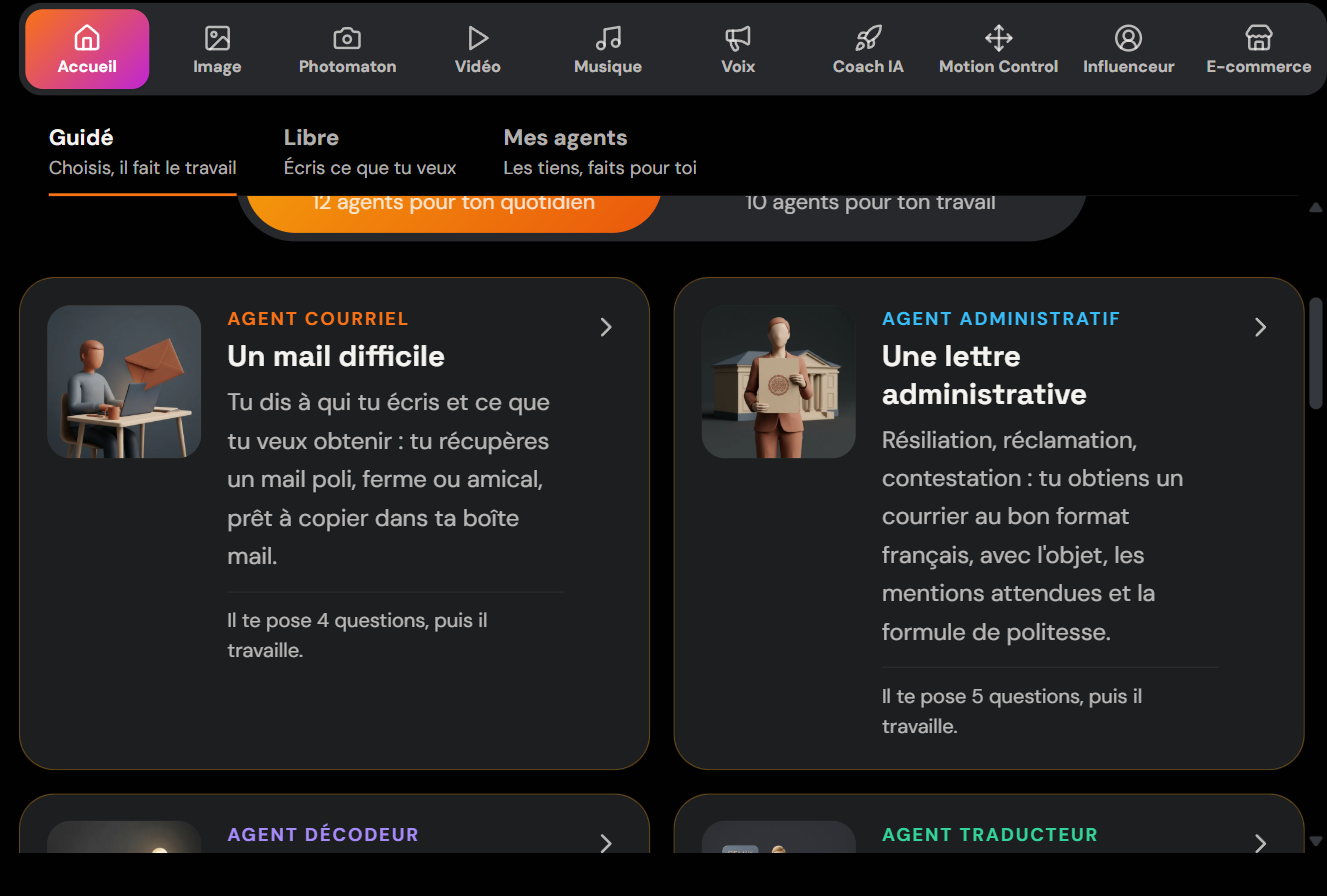
In practice, for a cancellation:
- Open the AI Lab, Home tab, Guided section.
- Choose the „An Administrative Letter" card.
- Answer the questions (recipient, type of request, reference, reason, what you're asking for).
- Grab the letter, proofread it, adjust, and copy it.
Writing a letter is just one example. Skilzy brings together more than fifteen programs to learn and use AI in everyday life, from image generation to automation, with two state-recognized certifications that are eligible for funding. To see where this tool fits into your journey, our guide to learning AI in 2026 as a beginner lays out the full path.
Method 2: Start From a Free Official Template
If you want a legally airtight text without inventing anything, start from a free official template on service-public.fr. The French government website offers up-to-date letter templates for most requests: cancellations, contesting a fine, complaints, consumer disputes.
How to do it:
- Go to service-public.fr and search for „modèle de lettre" followed by your request.
- Copy the template and replace the bracketed fields with your information.
- Check the legal articles cited: they add weight to your request.
The upside: the legal framework is reliable and free. The limit: a template stays generic. You have to adapt it to your exact situation, and if your case falls outside the anticipated scope, the template stops helping. That's where an assistant that reworks the text based on your situation takes back the advantage. You can even combine the two: start from the official template, then ask an AI to adapt it to your facts. Head straight to the letter templates on service-public.fr for your request.
Method 3: Use a Free AI Like ChatGPT
A general-purpose AI like ChatGPT can write a proper letter, provided you give it full context and proofread every line. It's free in its basic version, but the result depends entirely on what you provide.
A good message contains: who you are, who you're writing to, the type of request, the case reference, the dated facts, what you're asking for, and the tone you want (firm but courteous). The more precise you are, the less time you spend fixing it.
Two things to watch out for:
- Check the legal references: a general-purpose AI can cite an inaccurate article. Cross-check with service-public.fr.
- Never paste unnecessary sensitive data (full social security number, banking details) into a consumer tool.
If you're new to this kind of tool, our guide on how to use ChatGPT as a beginner explains how to word your requests. And if you're looking for other free resources, check out our selection for learning AI for free.
Cancel, Contest, Claim: What Each Letter Must Contain
Each type of letter has its mandatory details: a cancellation requires a contract reference and a reason, a contest a recap of the facts and the basis, a complaint a specific amount. Here's the breakdown.
| Letter | Absolute must-includes | Common pitfall |
|---|---|---|
| Cancellation | Contract number, sign-up date, reason or right to cancel, desired effective date | Forgetting the notice period set in the contract |
| Contest | Recap of the dated facts, reference of the disputed document, basis (article, deadline, error), attachments | Missing the contest deadline |
| Complaint | Description of the problem, order reference, amount or gesture requested, response deadline | Staying vague about what you expect |
Three useful reminders:
- Cancellation: since the 2023 law on three-click cancellation, many contracts signed online can also be canceled from your account area. The letter is still useful to keep proof and for contracts signed offline.
- Contest: respect the deadline stated on the document (often 45 days for a fine). Past the deadline, your contest is automatically rejected.
- Complaint: put a number on what you're asking for (refund, goodwill gesture) and set a reasonable response deadline, for example 15 days.
Send Your Letter So It Really Counts
For a letter to carry evidentiary weight, send it by registered mail with acknowledgment of receipt: you prove the recipient received it, and on what date. That's decisive when a legal deadline is running, or in case of a dispute later on.
Good sending practices:
- Keep a dated copy of your letter and the mailing receipt.
- Electronic registered mail carries the same legal weight as paper for most requests, and often costs less.
- For a simple reminder with nothing at stake, an email is enough, but keep proof of sending.
- Note the sending date and the response deadline in your calendar so you can follow up at the right time.
A well-written letter sent without proof loses half its force the day the recipient claims they never received it.
Conclusion
A letter that works isn't a nicely turned one: it's precise, targeted, and traceable. Gather your references and dates, choose your method (the guided agent for speed, the official template for the legal framework, a general-purpose AI if you already know your way around), then send by registered mail as soon as the stakes justify it. With these habits, you go from a blank page to a letter that gets a response.