


You've put an item up for sale, the photo is decent, the price is reasonable, and yet nothing happens. The problem almost always comes from the text. On Leboncoin and on Vinted alike, the listing is the only thing that speaks to the buyer when you're not there. A vague title, a three-word description, or missing information, and the buyer moves on to the next listing in a second.
The good news: a listing that sells always follows the same recipe. A precise title, a fair price, a description that answers questions before anyone asks them, good photos and the right keywords. In this guide, you'll see what makes the difference between a listing that sits idle and one that triggers messages, then three concrete methods to write it, from the fastest (with AI) to the most manual. By the end, you'll know how to produce a ready-to-publish listing in just a few minutes.
Why Most Listings Don't Sell
Most listings don't sell because they describe an object instead of making people want to buy it. The classic mistake is to write what you see („grey sofa, good condition") instead of writing what the buyer is looking for: the dimensions, the brand, the year, the reason for selling, the real condition and what's included.
A buyer who's hesitating always asks the same questions. Will it fit in my place? Is it really in good condition? Why is it being sold? Can I come pick it up this weekend? If your listing doesn't answer, two things happen: either the person sends you a message to ask (and many don't have the patience), or they give up. Every unanswered question is a sale slipping away.
The other big obstacle is a lack of trust. On a peer-to-peer platform, the buyer doesn't know you. A description that's too short or full of typos sends a negative signal, even unconsciously. Conversely, a detailed listing, honest about the flaws and well written, reassures. Selling online is one of the simple ways to make money with AI without any technical skill, as long as you take care with this first written contact.
The Six Ingredients of a Listing That Sells
A listing that sells rests on six elements: a precise title, a fair price, a clear description, good photos, the right keywords and a quick reply. Here's how to work on each one.
- The title. This is what decides whether someone clicks. Put the brand, the model, the size or color, and a word that reassures. „Zara camel wool coat size M, excellent condition" beats „nice coat" every time. On Vinted, the brand and size are essential; on Leboncoin, the brand and the exact model.
- The price. Look at what identical items are actually selling for, not the ones that have been listed for three months. A price 10 to 15% below the market sells fast. If you're open to negotiating, say so („price slightly negotiable").
- The description. Answer the questions in order: what it is, the precise condition (with the flaws), the dimensions or size, what's included, and the handover method (in-person pickup, shipping, location).
- The photos. Daylight, a neutral background, several angles, and a photo of the flaws. Visual honesty avoids disputes and reassures.
- The keywords. Think about the terms the buyer types. For a console, add „controller", „cables", „original box". These words help your listing rise in the search results.
- Responsiveness. A reply within the hour multiplies your chances. On Vinted, sellers who reply quickly are ranked higher.
Once these six elements are in place, writing it takes only a few minutes. What's left is choosing how you produce the text.
Method 1: Write Your Listing With Skilzy's AI
The fastest way to get a ready-to-publish listing is to have it written by a guided agent in Skilzy's AI Lab: you answer two or three questions, and it writes the full text. No need to know how to phrase a prompt — the agent asks you the right questions for you.
Skilzy is a French platform for learning and using AI in everyday life. Its AI Lab includes the real tools with credits built in, so you use AI directly inside the platform without stacking up subscriptions. For a listing, you pick the matching guided agent, you enter the item, its condition and its price, and it hands you back a catchy title plus a structured description, with the keywords already placed.
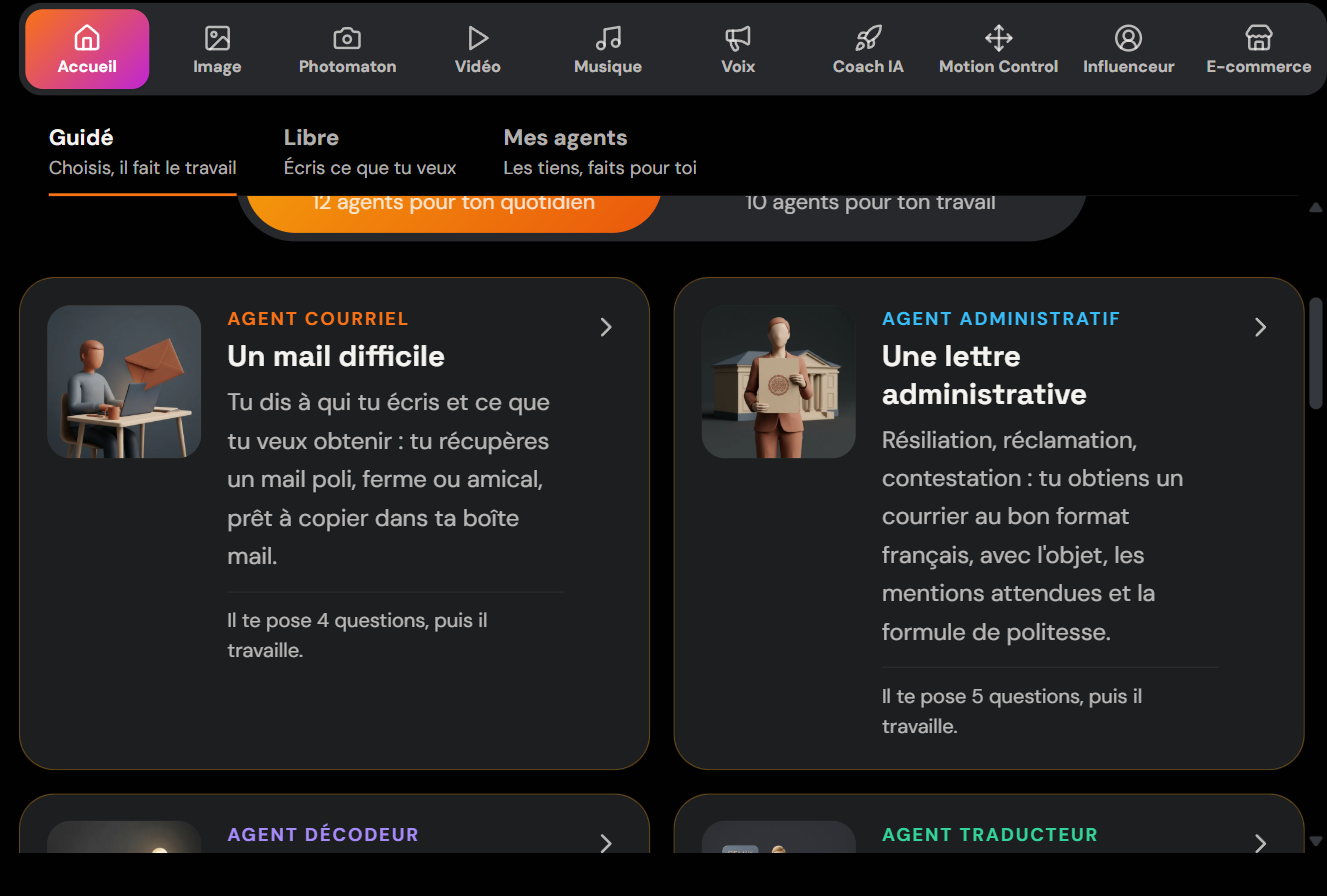
The path in the app: you open the AI Lab, the Home tab, the Guided section, then you select the writing agent. It asks two or three questions (what are you selling, what condition, what price, what handover), and it writes. You proofread, tweak a detail, and publish.
If you want to go further, Skilzy also offers two state-recognized certifications that are eligible for funding.
This approach really pays off if you sell regularly, for example in buy-and-resell or a serious closet clear-out. It's also a directly marketable skill: writing listings and product descriptions for shop owners is one of the services covered in Skilzy's AI freelance program, which shows how to turn these routines into income. If the topic interests you, our article on becoming an AI freelancer details the services to sell and the rates people charge.
Method 2: Use a Free AI Tool Like ChatGPT
You can also write your listing with a free AI tool like ChatGPT, as long as you give it a good prompt. The free version is enough for this kind of short text. The only work on your side is to describe your item well, because the AI can't guess what it doesn't see.
Here's a prompt template you can copy and fill in:
Write a for-sale listing for [Leboncoin / Vinted]. Item: [name, brand, model, size or dimensions]. Condition: [new, excellent, good, with these flaws: ...]. Price: [amount], negotiable or not. Handover: [in person at ..., or shipping]. Give me a catchy title under 60 characters, then a description of 4 to 6 lines, honest, with the keywords useful for search. Warm and direct tone.
The upside: it's free and available everywhere. The limits: you have to open an account on a separate tool, copy-paste the result to your platform, and the prompt is still yours to write every time. If you're churning out lots of listings, it gets repetitive, whereas a guided agent already does the formatting work. To go further with this kind of automation, our guide on AI workflows for creating content shows how to save time on your texts in bulk.
Method 3: Write Your Listing by Hand With a Template
If you prefer to write everything yourself, a five-block template is enough to structure an effective listing. No AI needed: you simply fill in each part in order.
- Title. Brand + model + size or dimension + condition. Example: „Rockrider mountain bike 27.5 inches, excellent condition".
- The item in one sentence. What it is and who it's for. „Full-suspension mountain bike, ideal for trails and the city."
- The condition, honestly. „Excellent overall condition, a few micro-scratches on the frame, brakes serviced in June."
- The practical info. Dimensions or size, accessories included, year, warranty if any.
- The handover and contact. „In-person pickup in Lyon 3rd district or Mondial Relay shipping at your cost. Available evenings and weekends."
This format works because it answers the questions in the order the buyer asks them. Keep sentences short, avoid all-caps everywhere (it feels like shouting) and proofread for typos. A hand-written listing can sell perfectly well; it just takes a little more discipline not to forget anything.
Adapting Your Listing to Leboncoin or Vinted
Leboncoin and Vinted don't expect the same listing: one favors the object and the price, the other fashion and trust between members. The very same text copy-pasted onto both platforms will rarely be optimal.
On Leboncoin, you sell everything (furniture, appliances, tech, cars, fashion). The buyer often searches locally, in-person pickup is the norm, and price matters enormously. Lean on precise dimensions, a well-chosen category and a clear location. The platform's posting rules require accurate, non-misleading listings; you can check them in the Leboncoin help center.
On Vinted, it's mostly fashion and accessories, with a buyer protection system and a rating system that builds your reputation. Here, the brand, the size and the condition come first, style hashtags help you get found, and shipping is built in. A slightly more personal tone works better („worn twice, too small for me"). Best practices for descriptions are explained in the Vinted help center.
In practice: keep the same base of information, but reorder it. For Leboncoin, the title highlights the item and its key feature; for Vinted, the brand and size come first. This adaptation logic is exactly what AI does well: you give it the info once, and it produces two calibrated versions.
Conclusion
A listing that sells is nothing mysterious: a precise title, a fair price, an honest description that answers the questions, good photos and a quick reply. You can write it yourself with a template, hand it off to a free tool, or produce it in a few minutes with a guided agent. Choose the method that fits your pace, test it on one item, and watch how many messages you get. The difference is often visible within the first week.