


A raise is won before the meeting, not during it. The rule is simple: you show up with quantified proof of what you bring, a specific number, well-chosen timing, and a pitch you've rehearsed out loud. If you improvise, the conversation happens to you. If you prepare it, you lead it. This guide shows you exactly what to gather, how to build your argument (including getting help from AI to find the right words and practice), how to run the conversation, and what to say if your employer says no. Everything here is designed for a complete beginner: no negotiation knowledge required, just a bit of method and an hour of serious prep. By the end, you'll know how to make your request in a calm voice, with arguments that hold up.
Why a Raise Is Prepared Like a Case File
A successful raise request rests on facts, not feelings: your employer needs concrete reasons to say yes. Saying "I work hard" or "life is expensive" isn't enough, because those statements are true for everyone and prove nothing about your specific value.
What moves a decision is a case file. Here, a case file is three things brought together:
- Your measurable results: revenue generated, hours saved, clients retained, projects delivered, mistakes avoided.
- How your role has grown: the responsibilities you carry today that you didn't carry when you were hired.
- Your market value: what comparable profiles earn, for the same job and the same level of experience.
Prepare these elements in writing. Not to read them during the meeting, but because writing them down clarifies your thinking and gives you confidence. A manager can spot in ten seconds the difference between someone who has thought it through and someone who's just hoping. You want to be in the first category.
Quantifying Your Value: The Proof to Gather
Before you talk to anyone, turn your work into numbers and compare yourself to the market. This is the most overlooked and most decisive step: without data, your request stays one opinion against another.
Start by listing your accomplishments from the past twelve months and put a number next to each one. A few examples to help you translate:
- "I took over managing social media" becomes "I grew our audience from 4,000 to 9,000 followers in a year."
- "I help the new hires" becomes "I train every new arrival — three people this year — which cut their ramp-up time."
- "I handle client disputes" becomes "I saved 8 clients who were threatening to leave, for an amount of X dollars retained."
Next, place yourself on the market. Salary benchmarks by job and region exist: government labor statistics publish pay distributions, and recruitment firms' compensation surveys give ranges by role. The goal isn't to find a magic number, but to know whether you're paid below, within, or above your range. That information completely changes the tone of your request.
If, as you dig, you realize your job is worth significantly more elsewhere, keep that fact in your back pocket. It'll serve you either in the negotiation or later for other career decisions.
Method 1: Build Your Pitch with Skilzy's AI Lab
The fastest way to go from a pile of notes to a clear pitch is to get help from a guided assistant that asks you the right questions and writes with you. That's exactly what Skilzy's AI Lab offers — the platform for learning and using AI. You're not writing into the void: you pick a small guided agent, it asks you two or three questions, then it shapes a clean piece of text.
In the Lab, open the Home tab, then the Guided section. There you'll find agents like "A Difficult Email" or "An Official Letter," perfect for a sensitive request where tone matters as much as substance.
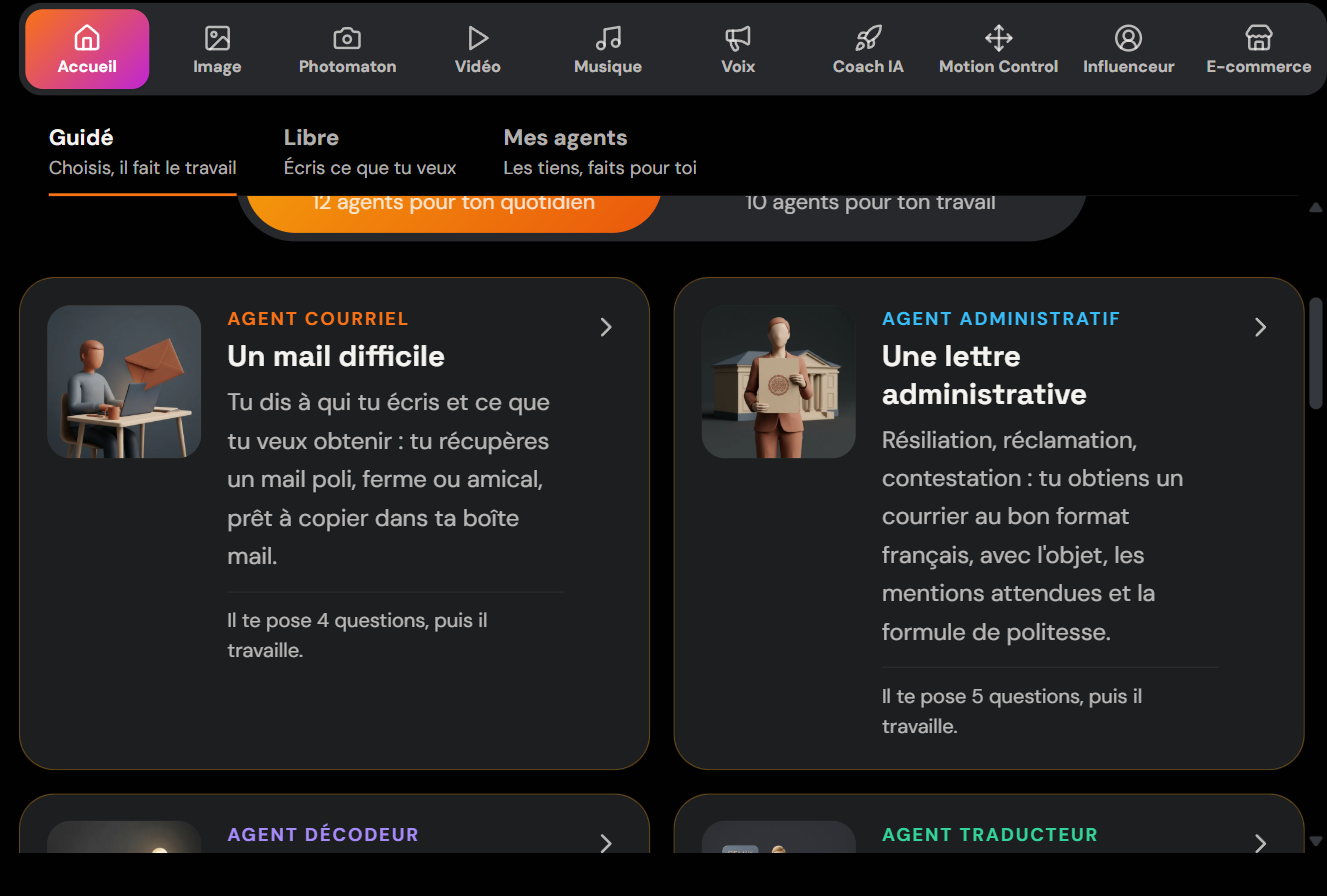
Concretely, you can ask it to:
- turn your proof into three short, punchy arguments, in the right order (the strongest first);
- write the email requesting a meeting, the one that gets you a slot without revealing the number in advance;
- prepare your answers to the objections you're dreading ("not the right time," "no budget");
- play the role of your manager so you can practice: you write what you'd say, the AI replies like a cautious boss, and you adjust.
The advantage of Skilzy is that the real tools are built in (credits are included), so you don't have to juggle several subscriptions to write, rephrase, and then practice.
One last tip: never repeat AI text word for word out of your own mouth. Use it as a first draft and a practice partner, then rewrite it in your own words so it sounds true to you. If the topic interests you more broadly, our guide on 10 AI workflows for creating content shows the same logic applied to other writing tasks.
The Other Methods for Practicing
If you prefer other tools, you can prepare your request with a free general-purpose assistant or, more simply, the old-fashioned way. None of these methods is off-limits; they just take a bit more organization on your part.
Method 2: a free AI chatbot. Tools like the free versions of the major assistants can rephrase a pitch and simulate an interview. Paste in your notes, ask it to play the manager and throw hard questions at you. The catches: you have to write precise instructions yourself to get a good result, free versions are often capped on the number of messages, and you don't get step-by-step guidance like you would in a dedicated agent.
Method 3: practicing out loud with someone close. Nothing replaces actually saying your lines for real. Ask a friend or family member to play your boss and to cut you off, object, stay silent. You'll hear right away what rings false. It's free and brutally effective, but your partner knows neither your job nor your company's real objections.
Method 4: solo written prep. A notebook, your three arguments, your number, the target date. You rehearse in front of a mirror or record yourself on your phone to listen back. Zero tools, zero cost — but also zero outside feedback: you risk going in circles.
The best move is often to combine them: build and practice with AI to move fast and anticipate objections, then rehearse out loud with someone close for the natural feel.
The Meeting, Step by Step
A good raise meeting follows a precise order: the timing, the opening, the proof, the number, then the silence. Stick to this sequence and you'll keep your thread even if the stress climbs.
- Choose the right moment. Aim for a period when the company is doing well, right after a win of your own, and never in the middle of a crisis. Annual reviews or a scheduled performance review are natural windows, but you can also ask for a dedicated meeting.
- Ask for a meeting, not an answer on the fly. A short email like "I'd like to review my role and how it's developing — would you have 30 minutes this week?" is enough.
- Open on something positive and concrete. Recap in one sentence what you like about your work, then move on to your results.
- Run through your three pieces of proof, the strongest first. Stay factual: numbers, examples, no complaints.
- State a specific number. "I'd like to move to X dollars gross" beats a vague "a raise." A precise number shows you've done your math.
- Then go quiet. After you've put your number on the table, let the silence sit. It's uncomfortable, and that's exactly why it works: you make room for the answer.
Keep a calm voice and a slow pace. You can have your notes in front of you — no one will hold it against you for being organized.
Handling a No or a "We'll See"
A no is almost never final: it's the start of a negotiation, as long as you stay calm and ask the right question. The worst reaction would be to apologize or leave offended. The best: seek to understand and to set up a next step.
If you're told no, simply ask: "What would you need to be able to say yes, and by when?" That question turns a flat refusal into a roadmap. You get either clear objectives ("if you hit this result within six months") or the admission that the budget is frozen this year.
If the salary won't move, open up other levers: remote work days, a performance bonus, funded training, a revalued title, extra time off. These trade-offs have real value and often unlock more easily.
Finally, if you realize your role is worth significantly more elsewhere and your employer refuses to take that into account, keep your options open. Many people are now building a supplementary income or an exit door by selling in-demand skills: that's the whole point of our program for becoming an AI freelancer, which shows which services to bill and at what rates. Knowing your market value, including as an independent, is the best negotiating lever there is. To go further, also read our article on how to become an AI freelancer and the one on realistic ways to make money with AI.
Conclusion
A raise request isn't won on charisma but on preparation: quantified proof, a clear number, well-chosen timing, and a rehearsed pitch. Gather your case file, build your argument (AI helps you do it in minutes and acts as a practice partner), then speak in a calm voice and let the silence work for you. Even a no becomes useful if it leads to a deadline and objectives. You now have the method; all that's left is to book that meeting.