

A client who lets your invoice drag on isn't always acting in bad faith. Often your email got buried under a pile of others, the invoice is waiting on an internal approval, or the person simply forgot. The problem is that chasing it makes you uncomfortable: you don't want to come across as the aggressive supplier, but you want your money. So you put it off, the unpaid invoice settles in, and your cash flow takes the hit. This article gives you a clear method for writing an unpaid invoice email that stays firm on substance and courteous in tone, with ready-to-copy templates and the right sending rhythm. You'll see how an AI can draft your reminder in thirty seconds, which words to avoid so you don't put the client on the defensive, and what French law lets you claim on top of the amount owed. The goal is simple: get paid without breaking the relationship.
Why a Badly Worded Reminder Costs More Than Waiting
An effective reminder stays short, factual and polite: it restates the facts without accusing or threatening from the very first message. Most delays get resolved with one well-worded email, provided you don't start off on the wrong foot.
The classic mistake is writing in the heat of irritation. A sentence like "I'm surprised I still haven't been paid" immediately puts the client in the wrong. If they had just forgotten, you've just turned an oversight into tension. And if the delay stems from a real issue on their end (a slow accounting department, a missing document), you come across as someone who accuses before understanding.
A good reminder does three things: it restates the precise invoice details (number, amount, due date), it offers an easy way out ("the invoice may have slipped through unnoticed"), and it asks for a clear action ("can you confirm the payment date?"). You stay in control of the tone, you keep the relationship, and you get a faster reply. That's exactly what the templates and tools below do.
Method 1: Let a Guided Agent From the Skilzy Lab Write Your Reminder
The fastest option is to describe your situation to a guided AI that asks you two or three questions, then drafts the email for you, tone included. No template to hunt down, no wording to weigh: you answer, it writes.
In the Skilzy AI Lab, the Guided tab offers mini agents designed for concrete everyday work situations. The "A Difficult Email" card is made exactly for this: you say you want to chase a client about a late invoice, you specify the amount, the due date and the desired level of firmness, and the agent hands you an email ready to send.
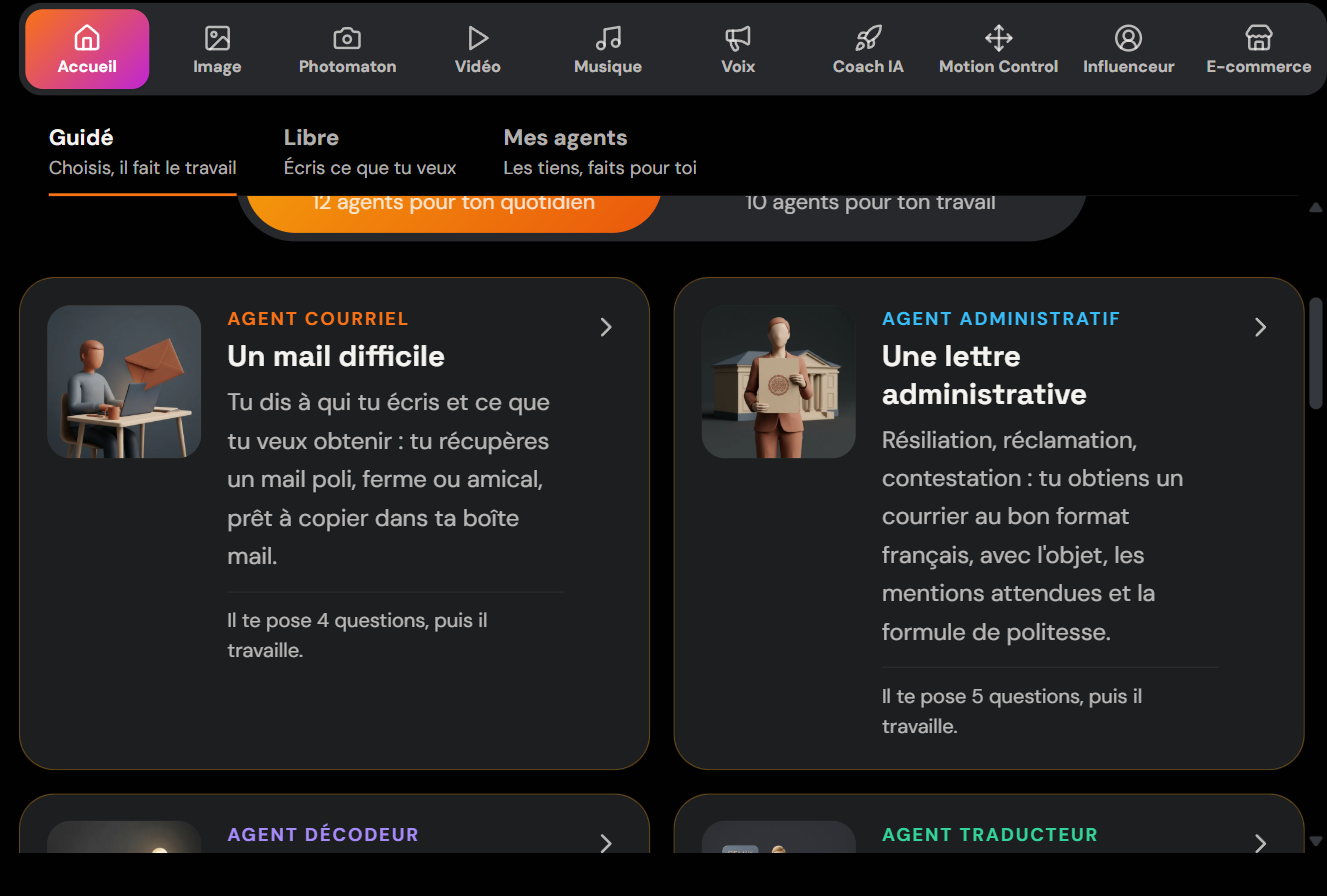
When you're just starting out, the benefit is not getting stuck in front of a blank page or a prompt to write. The agent guides you, and you tweak a couple of words if needed. You can ask it for three versions: a gentle reminder, a firm reminder and a formal notice. You keep the right one, personalize the first name and the invoice number, and send.
If managing your clients becomes a real topic, the program to become an AI freelancer teaches you to use these tools day to day to invoice, chase and track your activity without spending your evenings on it.
This approach combines well with the rest of your setup: if you want to industrialize your sends, read our guide to automating your emails with AI.
Method 2: Start From a Reminder Email Template to Personalize
If you'd rather keep full control, a good reminder email template always follows the same structure: clear subject line, restated facts, precise request, courteous closing. Here's a template you can copy as is and adapt.
Subject: Invoice No. 2026-084: friendly reminder
Hi [First name],
I hope you're doing well. I'm just following up regarding invoice No. 2026-084, for the amount of 1,200 euros, due on 10 August. It may have slipped through unnoticed on your end. You'll find it attached. Could you confirm its scheduled payment date?
Thanks so much and have a great day, [Your signature]
The tone hardens very gradually across the reminders. Here's how to adapt the same email depending on the stage:
| Stage | Tone | Key phrase |
|---|---|---|
| Reminder 1 | Friendly | "It may have slipped through unnoticed." |
| Reminder 2 | Neutral and factual | "Unless I'm mistaken, this invoice remains unpaid to date." |
| Reminder 3 | Firm | "Without payment within 8 days, I'll be obliged to apply the penalties provided for." |
Always keep the subject line precise with the invoice number: it makes the email findable and serious. Avoid capital letters, multiple exclamation marks and passive-aggressive phrasing. A well-written template saves you from reinventing the wheel for every client, but remember to adjust it: a copy-pasted email without the right first name makes a bad impression.
Method 3: Automate Reminders With Your Invoicing Software
Most invoicing software includes a free automatic reminder feature that sends an email on your behalf at dates you define. If you issue a lot of invoices, this is the most time-efficient option.
Tools like standard invoicing software (often included in your accounting package or your management tool) let you schedule a sequence: a reminder the day before the due date, another 3 days after, a final one at 15 days. The system sends the emails, attaches the invoice and stops the sequence as soon as the payment is received. You no longer have to do a thing until a client replies directly.
The limitation of this method is the tone: automatic messages are generic and sometimes cold. For a large strategic client, a manual, personalized reminder is still preferable. Best practice is to combine the two: automation for the routine flow, a hand-written email (with or without AI) for the sensitive cases.
If you want to go further in automating your operations, our article on automating your business with AI details the building blocks to assemble to link invoicing, reminders and tracking.
The Right Reminder Sequence: How Many Emails and at What Pace
Three to four spaced-out reminders are enough in the vast majority of cases, ramping up in firmness while never insulting the client. Too many closely spaced reminders are irritating; too few let the unpaid invoice settle in.
Here's a sequence that works for an invoice between businesses:
- Day +3 after the due date: first reminder, friendly tone. You assume it's an oversight.
- Day +10: second reminder, neutral and factual tone. You restate the due date and ask for a firm payment date.
- Day +20: third reminder, firm tone. You mention the late-payment penalties and offer a call to unblock the situation.
- Day +30: formal notice by email (and ideally by registered letter). This is the last step before a legal procedure.
Between two emails, a short phone call often changes everything: it shows you're following the matter closely and it lets you understand any blockage. Keep a written record of every exchange: in the event of a dispute, this history matters. And never wait two months to launch the first reminder; the longer you wait, the more the unpaid invoice starts to feel normal to the client.
What French Law Lets You Claim
Any invoice between businesses paid late gives rise to late-payment penalties and a flat-rate collection fee of 40 euros, provided for by the French Commercial Code. Mentioning it in your firm reminder is not aggressive at all: it's your right.
In practice, from the day after the due date, you can apply late-payment penalties (the rate must appear on your invoice; failing an agreement, a legal reference rate applies). On top of that comes a flat-rate fee of 40 euros per invoice to cover your collection costs, automatically due for any late professional payment. You can consult the official rules on late-payment penalties between businesses and the provisions on the flat-rate 40-euro fee on the public websites.
These mentions should only be used from the third reminder onward, so you don't dramatize too early. Politely reminding the client that the law provides for these fees is often enough to unblock a payment, without you needing to actually invoice them. If the client stays silent after the formal notice, you can consider an order to pay (injonction de payer), a simple and inexpensive procedure for undisputed debts.
Conclusion
Chasing an unpaid invoice is nothing like a confrontation: it's a sequence of calm, precise and increasingly firm messages. Choose your method based on your time and the number of invoices: a guided AI to draft quickly and well, a template to personalize if you like keeping control, or your software's automation for the routine flow. Apply the right sequence, keep your written records, and remind clients of your rights at the right moment. You'll get paid faster, and your clients will keep working with you.