


Every Sunday night, the same question comes up: what are we eating this week? You open the fridge, jot down two or three ideas, forget half the ingredients at the store, and by Wednesday you end up ordering a pizza. Artificial intelligence solves this headache in a few minutes. You give it the number of people, your constraints (time, budget, allergies), and it hands you seven balanced dinners along with a grocery list sorted by aisle.
In this guide, you'll discover three concrete ways to create your weekly meal plan and an automatic grocery list: first with Skilzy's AI Lab, then with a free assistant like ChatGPT, and finally with dedicated meal-planning apps. Each method is explained step by step, with the exact prompt to copy. You don't need any technical skills — just the ability to write down what you want to eat.
Why plan your weekly meals with AI?
Planning your meals with AI saves time and money and cuts down on waste: in a single request, you get balanced meal plans and a complete grocery list, instead of improvising every night. It's the difference between thirty minutes of thinking spread across the week and five minutes done once and for all.
Food waste is a real expense. According to ADEME, each person in France throws away nearly 30 kg of food per year on average, part of which comes from poorly planned purchases. When you head to the store with a precise list built around recipes you're actually going to cook, you buy less and throw out less.
AI also helps you add variety and balance. You can ask it to alternate between meat, fish, legumes, and vegetarian dishes, following the broad principles of the official nutritional guidelines from the Manger Bouger program. In short: you hand off the tedious part (coming up with ideas, making the list) and keep the fun of cooking.
Method 1: Generate your meal plans and grocery list with Skilzy's AI Lab
The simplest way to create your meal plans and grocery list is Skilzy's AI Lab: you pick a guided agent, answer two or three questions, and it writes everything for you. No blank page, no prompt to dream up: the tool asks you the right questions in the right order.
In the AI Lab, go to the Home tab, then the Guided section. There you'll find a catalog of mini agents, each designed for a specific task. You pick one, it asks for the number of people, your constraints, and your cravings, then sends you back a complete meal plan and its grocery list.
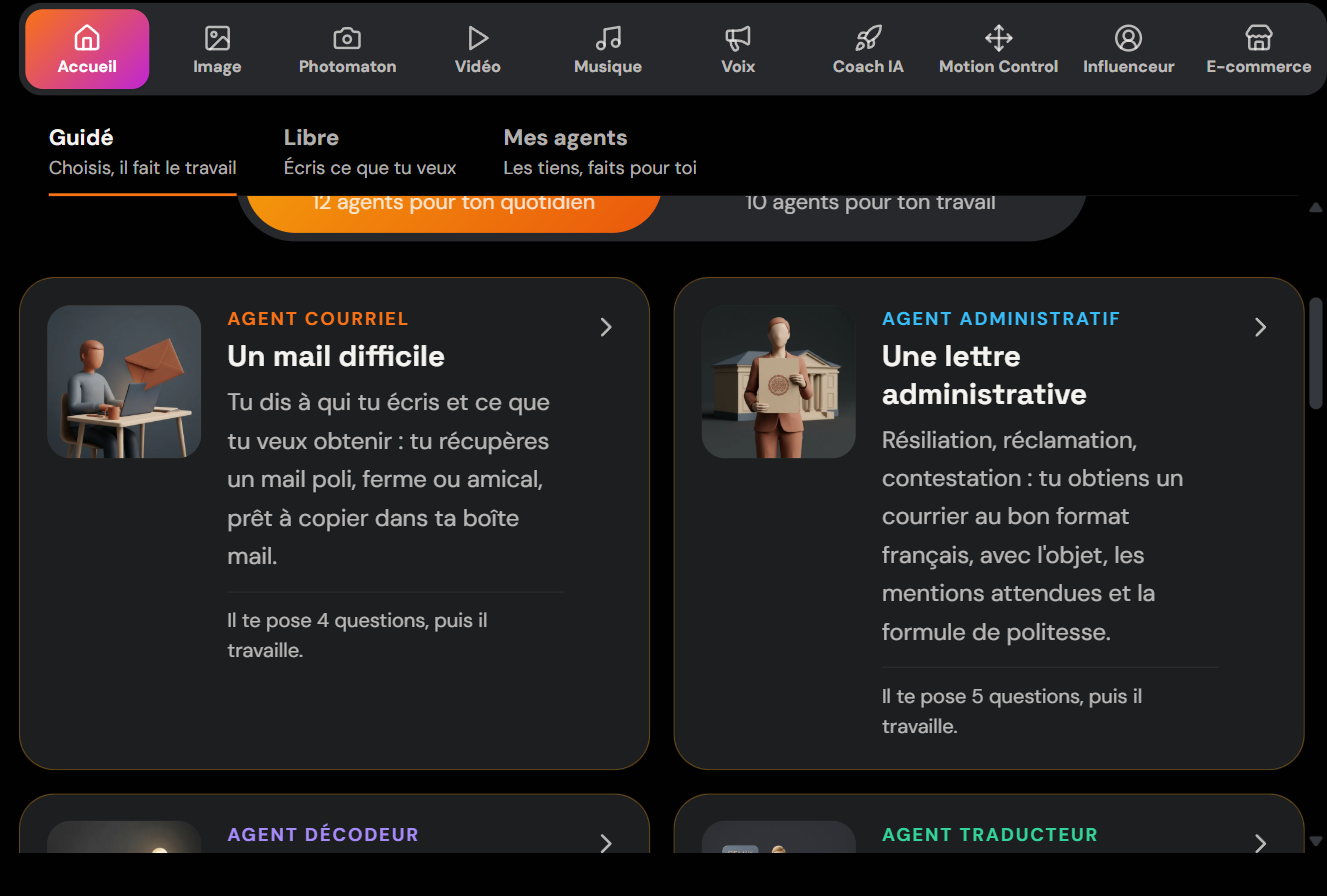
The beauty of the Lab is that you use real AI tools directly inside the platform, with credits included, without piling up subscriptions. Skilzy is a French platform for learning and using AI in everyday life, and organizing your meals is just one example of what you can automate once you get the hang of it. If you want to see everything that's covered, take a look at the different Skilzy programs: writing, images, automation, and plenty of other practical uses.
Method 2: Use a free AI assistant like ChatGPT
A free AI assistant like ChatGPT does the job too: you open a conversation, paste in your prompt, and get your meal plans back in a single reply. It's the catch-all solution, handy if you already use the tool for other things.
The steps are simple. You open a new conversation, write out your request (you'll find a complete prompt template further down in this article), and get seven dinners with the list of ingredients. If a dish doesn't appeal to you, you reply „swap Thursday for a vegetarian dish" and the AI fixes just that line.
Two limits to keep in mind. First, the free version can be slowed down or restricted during peak hours. Second, if you're just starting out, writing a good prompt on the first try isn't easy — which is exactly what a guided agent does for you. If you've never used the tool, start with our guide on how to use ChatGPT when you're a beginner; it'll save you time.
Method 3: Dedicated meal-planning apps
Specialized apps like Jow, Frigo Magic, or Mealime offer ready-made meal plans and generate a grocery list linked to delivery. They're useful if you want a catalog of already-photographed recipes and a cart that fills itself at your local store.
Their advantage is integration. You choose your dishes, the app calculates quantities based on the number of diners, and sends the list straight to an online grocery service. Some even read the contents of your fridge to suggest anti-waste recipes.
Their limits, on the other hand, are real. You're locked into the app's catalog: it's hard to break away from a set recipe or to impose an unusual constraint (a very tight budget, a specific diet, an ingredient you need to use up). Many also run on a separate subscription, and some features are reserved for the paid version. A general-purpose AI assistant stays more flexible: you talk to it in your own words, and it adapts.
The right prompt for a successful weekly meal plan
A good prompt for a weekly meal plan fits in one precise sentence: number of people, days involved, budget, dietary constraints, and prep time. The clearer you are, the better the result. Here's a template to copy and adapt:
Put together a meal plan for the 7 dinners of the week for 2 adults and 2 children. Budget of about 70 euros. No pork, at least one vegetarian dish. Each recipe should take less than 30 minutes to prepare. At the end, add the complete grocery list, with quantities, sorted by aisle (produce, fresh goods, pantry, frozen).
A few tweaks that change everything:
- Specify the time available: „under 20 minutes on weeknights, a longer dish on the weekend."
- State what you already have: „I've got zucchini and rice to use up."
- Ask for it sorted by aisle: your list becomes usable as-is at the store.
- Add a variety constraint: „not the same starch twice in one week."
Knowing how to word this kind of request is a skill that will serve you everywhere. If the topic interests you, our guide to learning AI as a beginner covers the basics of writing clear instructions.
Adapting the meal plans to your family and your budget
AI adapts the meal plans to your situation in seconds: allergies, a tight budget, picky kids, or express meals — you just have to say so in your request. You don't get a generic menu, but a plan built for your household.
A few concrete cases. Tight budget? Ask for a „menu under 50 euros for the week, favoring legumes and seasonal vegetables." Kids who pout at vegetables? Specify „recipes that appeal to children, with the vegetables worked into the dish rather than served on the side." Something comes up on Tuesday? Reply „on Tuesday I get home late, suggest a dish under 15 minutes" and the AI recalculates just that day.
This logic of delegating applies to all of family life. The same reflex (give clear context, let the AI suggest, adjust) works, for example, to help your child do their homework without giving them the answers. Once you've grasped the principle with meals, you reuse it everywhere in your week.
Conclusion
Planning your meals and grocery list shouldn't cost you your Sunday evening anymore. With a guided agent from Skilzy's AI Lab, you get a balanced meal plan and an aisle-sorted list in five minutes, without knowing how to write a single prompt. A free assistant or a dedicated app do the job too, each with its own limits.