

Your child is stuck on a math problem, an essay, or a history lesson, and you're wondering whether artificial intelligence can help without doing the work for them. The answer is yes, with one condition: you have to set it up so it explains, asks questions, and gets your child thinking, instead of just spitting out the solution. A tool like ChatGPT or Skilzy's AI Lab can play the role of a patient tutor, available in the evening when you have neither the time nor the knowledge to go over everything. You just need to know what to ask it. You're about to see how to turn AI into homework support that actually guides, with concrete methods, copy-paste prompts, and simple rules to keep your child from just copying. The goal isn't to finish homework faster: it's for them to understand, and to be able to do it on their own next time.
Can AI Really Help With Homework Without Cheating?
Yes, AI can explain a concept, guide reasoning step by step, and check work, without ever handing over a ready-made answer, as long as you ask it clearly. By default, a tool like ChatGPT tends to give the solution right away: that's exactly what you want to avoid. The good news is that it follows your instructions. If you tell it “don't give the answer, ask me questions so I can find it,” it completely changes its behavior and becomes a tutor.
The difference between cheating and learning comes down to one thing: who does the reasoning. If the AI solves the exercise, your child copies it and hasn't learned anything. If the AI explains the rule, gives a similar example, and lets them work at it, they make progress. France's Ministry of Education actually regulates these uses and publishes guidance on artificial intelligence in schools to help parents and teachers find their way.
In practice, AI is useful for three things: rephrasing a poorly understood lesson in simple words, generating extra practice exercises, and reviewing a piece of work by pointing out mistakes without correcting them outright. It replaces neither the teacher nor your presence, but it fills the moments when your child is alone with their worksheet.
Method 1: Skilzy's AI Lab, Guided Agents That Explain Instead of Answering
The simplest solution for a beginner parent is a space where the AI is already set up to guide: Skilzy's AI Lab offers guided agents that ask questions before writing, instead of dumping an answer. You don't need to know how to write a perfect prompt: you pick an agent, it asks you two or three questions, then it builds an explanation tailored to the situation. That's exactly how a good tutor works.
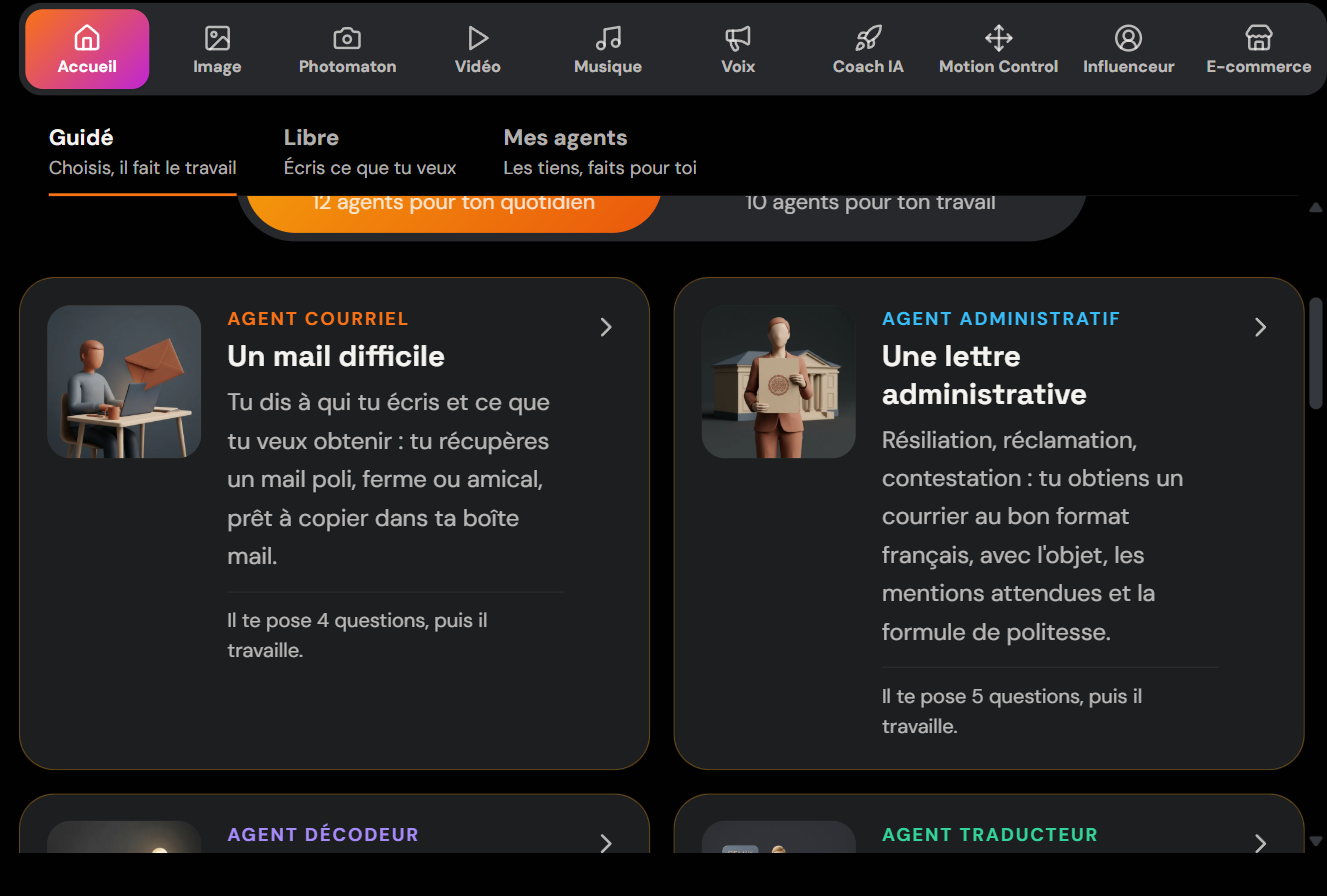
The upside for you: everything is in one place, without piling up paid subscriptions all over. The Lab includes the credits to use the real AI tools, and Skilzy also offers programs that teach you to really use them, not just to click around. If you want to understand how to write effective instructions for yourself and to help your child, take a look at Skilzy's programs for learning and using AI every day: you'll learn to phrase requests that make you think rather than just handing over ready-made answers.
Good to know: Skilzy also offers two state-recognized, fundable certifications, if you want to go further than an evening helping hand.
Method 2: Using ChatGPT or Claude Directly With the Right Prompts
If you'd rather use a tool like ChatGPT or Claude directly, that's possible and free in their basic versions: everything then comes down to how you phrase your request. These tools do what they're told. So the secret is to set a framework from the very first sentence, otherwise they'll give the answer.
Here's a starter prompt you can copy, replacing the brackets:
You are a caring private tutor for an [11-year-old] child in [6th grade]. Here is their exercise: [paste the problem]. Never give the answer directly. Explain the rule to me with a simple, different example, then ask me one question at a time so I can figure it out on my own. Correct my mistakes by explaining why, without doing the exercise for me.
This framing changes everything. The AI will break things down, ask questions, and encourage. You can add “use simple words” or “give me a hint if I get it wrong twice.” If you're a complete beginner with these tools, our guide to using ChatGPT as a beginner walks you through the basics step by step. And so you never have to hunt for wording again, our roundup of 50 useful prompts to use every day includes several learning-focused templates.
One thing to watch: these tools have an age limit and aren't designed to be used alone by a young child. Stay next to them—you're the one steering the conversation.
Method 3: Dedicated Homework-Help Apps
Finally, there are apps that specialize in academic support, often tied to the official curriculum, that now include AI features: they're more structured but less flexible. Services like grade-level review platforms, online course apps, or certain homework-help apps offer corrected exercises, study sheets, and sometimes an assistant that explains.
Their appeal: the content is aligned with the French curriculum, by subject and by grade, which is reassuring. Their limit: they often cost a dedicated subscription per child, stay centered on their own catalog, and the AI is sometimes so restricted that it just hands over the answer key, which doesn't help your child reason. Some are partly free, others fully paid.
These tools combine very well with the two previous methods. For example, you can review a lesson on a dedicated app, then use generative AI to create extra practice exercises when the app's are used up. One doesn't replace the other.
The Golden Rules So AI Helps Without Doing the Work
For AI to help your child progress instead of making them lazy, keep five simple rules in mind and apply them at every session. They're what separates real homework support from a copying machine.
- Ban the direct answer from the very first message. “Explain, don't solve” should be your reflex phrase.
- Stay present. AI is a tool, not a babysitter. Your child reads out loud, and you confirm the explanation is understood.
- Have them rephrase. After the AI's explanation, ask your child to re-explain it to you in their own words. If they can, you've won.
- Check the facts. An AI can get things wrong, especially in history, geography, or with dates. Cross-check with the textbook or notebook.
- Limit the time. A nudge on a sticking point, not the whole homework session. Personal effort remains essential.
And a reminder that goes for the whole family: never share sensitive personal data (full name, address, photo) in a conversation with an AI. You can check ChatGPT's official documentation to understand how conversations are handled.
Prompts by Subject to Copy Tonight
Each subject calls for a different angle—here are ready-to-use instructions that push the AI to guide rather than answer. Copy them and replace what's in brackets.
| Subject | Prompt to copy |
|---|---|
| Math | “Explain the method for solving this type of problem with a different example, then let me apply it to mine: [problem]. Don't do the calculation for me.” |
| Writing (essays) | “Here's the start of my essay: [text]. Don't rewrite it. Ask me three questions to make it richer and point out two grammar mistakes for me to fix myself.” |
| History/Geography | “Summarize this lesson in 5 simple points, then quiz me with three questions to check that I understood: [lesson].” |
| Foreign language | “Correct my sentences by underlining the mistakes without giving me the right version, and explain the grammar rule involved: [sentences].” |
| Science | “Explain this concept to me as if I were 10, with an everyday comparison, then ask me a question to see if I understood: [concept].” |
These templates work with any tool. The principle is always the same: the AI explains and asks questions, your child does the work. If you want to go further and understand how AI works without being an expert, our guide to learning AI as a beginner explains everything from scratch, no jargon.
Conclusion
Helping your child with homework using AI isn't about feeding them the answers—it's about giving them a patient tutor that explains and lets them work at it. The easiest way to start without going wrong is a ready-made space like Skilzy's AI Lab. But with the right prompts, ChatGPT or a homework-help app do the job too. Either way, the rule doesn't change: the AI guides, your child thinks, and you stay the conductor. That's how a homework assignment becomes a real learning moment.